







How Razor Shark plays
Razor Shark is easiest to understand by separating its ordinary round from the feature that changes the pace. Mystery stacks can land on any reel of the twenty-line board. A golden shark turns the covered positions into mini-reels with instant values or scatters.
The listed stake range is A$0.10 to A$100. Treat those as the published limits for the researched version, because an operator can offer a narrower range or convert denominations differently. The 20 lines format also determines how a displayed bet is spread across the board. The visual theme is Deep sea and Sharks, but it does not alter the random result or improve the published return.
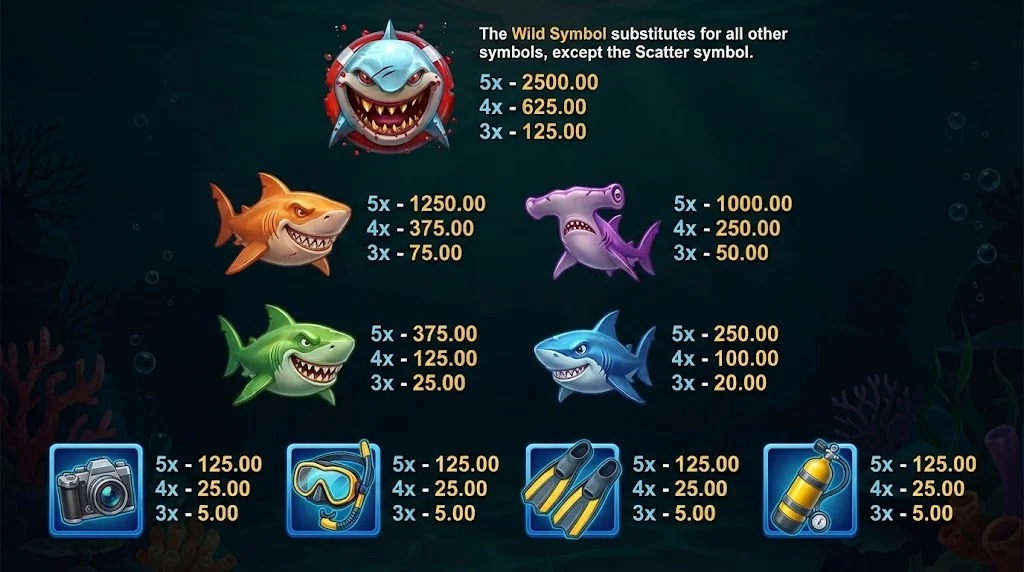
Razor Shark settles regular wins on 20 lines. A symbol merely appearing several times is not enough: it has to occupy the positions drawn by an active line and normally connect from the required starting reel. This is why the line display is worth opening before play. It shows whether the stake covers every pattern and stops a near-miss animation from being mistaken for a payable combination.
For Razor Shark, the maximum is listed as 85,475x reported. That is a cap or reported result for this specific version, not a likely session target. A useful demo session is about learning what triggers the features and how the bet display works, not proving whether the RTP is true from a small sample.
Before judging Razor Shark, open its help screen and locate four items: the active return setting, the definition of a winning 20 lines combination, the exact Mystery Stacks trigger and any market-specific restrictions on Free Games. Those details are more useful than watching a short run of spins. They also prevent a common mistake with similarly named sequels and cabinet editions: assuming that matching artwork means matching maths. This review follows the Push Gaming version in the fact card, so numbers from a clone or later sequel are not substituted.
Bonus features
Mystery Stacks
Mystery Stacks gives Razor Shark an additional state beyond the ordinary 5×4 round. Its trigger and settlement are automatic under the published rules, so there is no timing trick or spin pattern that can make it appear.
Razor Reveal
Razor Reveal gives Razor Shark an additional state beyond the ordinary 5×4 round. Its trigger and settlement are automatic under the published rules, so there is no timing trick or spin pattern that can make it appear.
Nudge and Reveal
Nudge and Reveal gives Razor Shark an additional state beyond the ordinary 5×4 round. Its trigger and settlement are automatic under the published rules, so there is no timing trick or spin pattern that can make it appear.
Free Games
Razor Shark’s Free Games changes the normal reel sequence and is the point at which the feature-specific rules matter most. In free games, mystery stacks on reels two and four nudge each spin and apply a growing multiplier, allowing one feature to continue far beyond its starting spins.
The four listed mechanics do not operate as four equal bonuses. Mystery Stacks defines how Razor Shark is usually recognised, Razor Reveal changes or extends that process, and Nudge and Reveal supplies the next layer of payout potential. Free Games is best treated as a modifier or secondary route unless the live rules say otherwise. Reading them in that order makes the feature sequence easier to follow than relying on animations alone.
RTP and volatility
Razor Shark’s published headline RTP is 96.7%. This is a long-run mathematical return, not a prediction for a session, and another operator build may be lower. Open the information panel and compare its figure with 96.7% before staking real money. Our RTP guide explains why a difference of even one percentage point matters only over large turnover but is still worth checking before play.
Razor Shark’s 96.7% headline return is around or above the common 96% reference point. That is useful for comparing versions, but it does not make the game low risk: high volatility can still dominate a short session. RTP ranks the long-run maths; it does not cancel the payout distribution described by volatility.
Razor Shark is classified as high volatility. On the volatility guide that means results can cluster unevenly, with losing stretches between the rounds carrying most of the potential. Volatility says nothing about whether the next spin wins; it describes how the same long-run return is distributed.
Razor Shark’s high profile places more weight on infrequent feature sequences and larger outliers. A short run can therefore finish without showing Mystery Stacks at all, while one feature can account for most of a longer session’s return. Reducing the stake extends observation time; raising it after losses only increases the amount exposed to the same unchanged maths.
For Razor Shark, the practical reading is simple: size the stake for the dry sequence, not for the advertised maximum. The 85,475x reported headline belongs to the far end of the paytable, while ordinary play is built from much smaller combinations.
Our verdict
Razor Shark is strongest when you want Mystery Stacks and Razor Reveal in a 5×4 format. Its 20 lines model is clear once the trigger rules are open, and the deep sea / sharks presentation gives the mechanics a distinct setting. The main reservations are the published 96.7% RTP and high volatility.
A fair comparison should place Razor Shark beside games with the same pay model and volatility, not simply another title sharing the deep sea theme. That keeps the decision focused on reel behaviour, feature access and return settings instead of artwork or a headline jackpot alone.
Razor Shark is not a strategy game and there is no stake pattern that changes its RNG. Use the paytable to verify the live version, keep the bet within a pre-set entertainment budget and stop when the session reaches that limit. As a review score, the mechanics are more persuasive than the maximum-win headline: the page should help you decide whether the format is enjoyable before any deposit is involved.