


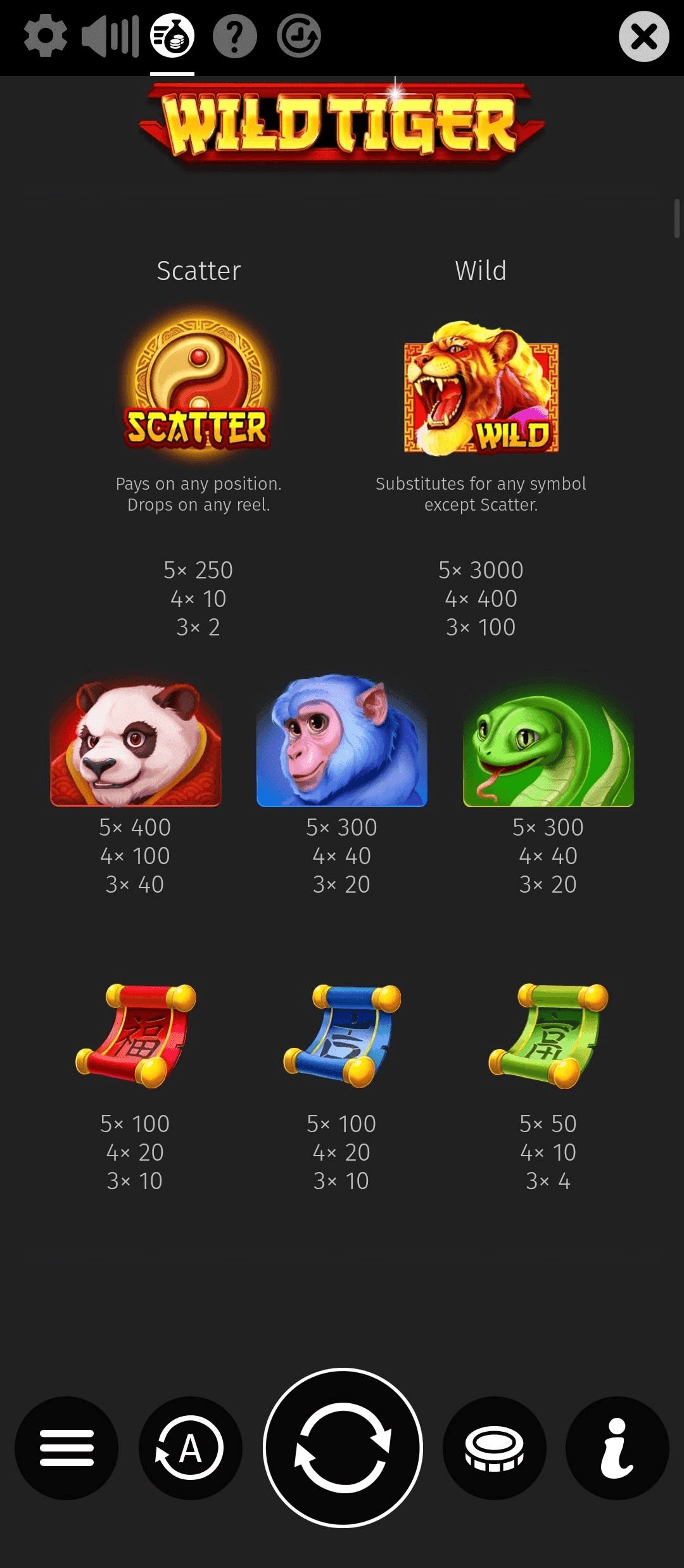





How Wild Tiger plays
The defining choice in Wild Tiger is not its theme but its pay system. Wild Tiger lets the player select from twenty to one hundred active lines on a 5×4 grid, so the total stake changes with line coverage.
The researched build lists A$0.20–A$150 per round. Its 20–100 adjustable lines win model is more useful than the reel count alone: it tells you which symbol positions can combine and why some screens pay while similar-looking ones do not. The visual theme is Asian tiger and Martial arts, but it does not alter the random result or improve the published return.
Wild Tiger settles regular wins on 20–100 adjustable lines. A symbol merely appearing several times is not enough: it has to occupy the positions drawn by an active line and normally connect from the required starting reel. This is why the line display is worth opening before play. It shows whether the stake covers every pattern and stops a near-miss animation from being mistaken for a payable combination.
For Wild Tiger, the maximum is listed as 3,000x. That is a cap or reported result for this specific version, not a likely session target. A useful demo session is about learning what triggers the features and how the bet display works, not proving whether the RTP is true from a small sample.
Before judging Wild Tiger, open its help screen and locate four items: the active return setting, the definition of a winning 20–100 adjustable lines combination, the exact Adjustable lines trigger and any market-specific restrictions on Turbo. Those details are more useful than watching a short run of spins. They also prevent a common mistake with similarly named sequels and cabinet editions: assuming that matching artwork means matching maths. This review follows the BGaming version in the fact card, so numbers from a clone or later sequel are not substituted.
Bonus features
Adjustable lines
Adjustable lines is part of the win-evaluation system, not a guarantee that a busy screen pays. In Wild Tiger, combinations are settled under the published 20–100 adjustable lines rules before any follow-up removal, collection or respin is applied.
Tiger Wild
Tiger Wild helps complete paying combinations in Wild Tiger, but its exact reel restrictions and multiplier behaviour belong to this BGaming version. It should be read from the paytable rather than assumed from another game carrying a similar symbol.
Scatter
Scatter gives Wild Tiger an additional state beyond the ordinary 5×4 round. Its trigger and settlement are automatic under the published rules, so there is no timing trick or spin pattern that can make it appear.
Turbo
Turbo gives Wild Tiger an additional state beyond the ordinary 5×4 round. Its trigger and settlement are automatic under the published rules, so there is no timing trick or spin pattern that can make it appear.
The four listed mechanics do not operate as four equal bonuses. Adjustable lines defines how Wild Tiger is usually recognised, Tiger Wild changes or extends that process, and Scatter supplies the next layer of payout potential. Turbo is best treated as a modifier or secondary route unless the live rules say otherwise. Reading them in that order makes the feature sequence easier to follow than relying on animations alone.
RTP and volatility
Wild Tiger’s published headline RTP is 97.16%. This is a long-run mathematical return, not a prediction for a session, and another operator build may be lower. Open the information panel and compare its figure with 97.16% before staking real money. Our RTP guide explains why a difference of even one percentage point matters only over large turnover but is still worth checking before play.
Wild Tiger’s 97.16% headline return is around or above the common 96% reference point. That is useful for comparing versions, but it does not make the game low risk: medium volatility can still dominate a short session. RTP ranks the long-run maths; it does not cancel the payout distribution described by volatility.
Wild Tiger is classified as medium volatility. On the volatility guide that means a balance between smaller regular returns and occasional feature-led swings. Volatility says nothing about whether the next spin wins; it describes how the same long-run return is distributed.
Wild Tiger’s medium-volatility label suggests that more of the return is distributed through ordinary wins than in an extreme bonus-first release. Even so, the 3,000x ceiling sits far beyond routine results. The sensible way to assess the game is to watch how often the base round remains understandable and whether Adjustable lines adds enough variety, not to chase the largest number on the loading screen.
For Wild Tiger, the practical reading is simple: size the stake for the dry sequence, not for the advertised maximum. The 3,000x headline belongs to the far end of the paytable, while ordinary play is built from much smaller combinations.
Our verdict
Wild Tiger is strongest when you want Adjustable lines and Tiger Wild in a 5×4 format. Its 20–100 adjustable lines model is clear once the trigger rules are open, and the asian tiger / martial arts presentation gives the mechanics a distinct setting. The main reservations are the published 97.16% RTP and medium volatility.
A fair comparison should place Wild Tiger beside games with the same pay model and volatility, not simply another title sharing the asian tiger theme. That keeps the decision focused on reel behaviour, feature access and return settings instead of artwork or a headline jackpot alone.
Wild Tiger is not a strategy game and there is no stake pattern that changes its RNG. Use the paytable to verify the live version, keep the bet within a pre-set entertainment budget and stop when the session reaches that limit. As a review score, the mechanics are more persuasive than the maximum-win headline: the page should help you decide whether the format is enjoyable before any deposit is involved.